
Our Services
What is amfori BSCI?
amfori BSCI (Business Social Compliance Initiative) constitutes a leading global supply chain management system that enables companies to drive social compliance and improvements within their global supply chains. It implements a holistic Code of Conduct based on international conventions, such as the Universal Declaration of Human Rights and the International Labour Organization (ILO) standards.
Core Purpose: To provide a rigorous auditing methodology that monitors and assesses workplace standards across the supply chain, ensuring continuous improvement in social performance.
Primary Objective: To facilitate open and sustainable trade by ensuring that manufacturers adhere to ethical principles, including fair remuneration, decent working hours, and the prohibition of child and forced labor.
Applicability: Essential for manufacturers and suppliers—particularly those exporting to the European market—who need to satisfy the ethical procurement requirements of amfori members (major retailers and brands).
Benefits
Access to European Markets: BSCI is the preferred standard for European retailers (like Lidl, Aldi, and Metro). Without it, it is very hard to sell to European buyers.
One Audit for Many Buyers: Once you are audited, your “Grade” is visible to all amfori members. You don’t need a separate audit for every customer.
Graded System: Unlike other audits that just say “Pass” or “Fail,” BSCI gives you a grade (A, B, C, D, or E). A good grade (A or B) proves you are a top-tier supplier.
Better Worker Morale: It ensures your workers are treated fairly and paid correctly. Happy workers are more productive and less likely to quit.
Reduce Risks: It helps you identify safety hazards (like blocked fire exits) or legal issues (like incorrect overtime pay) before they become lawsuits.
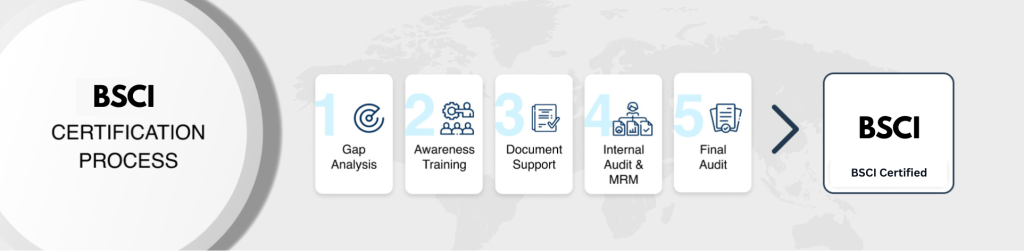
The Certification Process
Step 1: Gap Analysis
We inspect your factory and HR records. We check your current practices against the 13 Performance Areas of the amfori BSCI Code of Conduct to identify what is missing.
Step 2: Awareness Training
We train your management team. We explain strict rules like “No Bonded Labor,” “Fair Remuneration,” and “Occupational Health and Safety” so everyone understands the requirements.
Step 3: Document Support
We help you organize your records. We ensure your payroll, time attendance logs, and social policies are accurate and ready for inspection.
Step 4: Internal Audit & MRM
We do a “practice run” audit. We interview workers and inspect the facility to find any issues. We then hold a Management Review Meeting (MRM) to fix problems and improve your potential grade.
Step 5: Final Audit
An external auditor visits your factory. They check your documents, inspect the site, and interview workers to determine your compliance level.
Step 6: Success!
The auditor issues your final report with a Grade (A to E). This report is uploaded to the amfori platform for your customers to see.
Frequently Asked Questions (FAQ)
Q: Can I apply for a BSCI audit myself?
A: No. This is unique to BSCI. A Buyer (who is an amfori member) must invite you. They must hold the “RSP” (Responsibility) for your factory in the system to authorize the audit. You cannot just book it yourself.
Q: Is BSCI a certificate?
A: No. You do not get a “Certificate.” You get an Audit Report with a grade.
-
Grade A or B: Valid for 2 years.
-
Grade C: Valid for 1 year (you need to improve).
-
Grade D or E: You failed; you need a follow-up audit quickly.
Q: What is the difference between Sedex and BSCI?
A: Sedex is popular in the UK and uses the SMETA format (listing problems without a grade). BSCI is popular in mainland Europe (Germany, France, etc.) and gives you a specific Grade (A-E).
Q: What happens if I get a Grade D?
A: A Grade D means “Insufficient.” You are not blacklisted, but you must create a “Remediation Plan” to fix the problems and have a follow-up audit within 6 to 12 months.
Track Record — Successful Clients:
Here are some of the brands and factories we have guided to full certification: