
Our Services
What is MSPO?
The Malaysian Sustainable Palm Oil (MSPO) Certification Scheme constitutes the nationally mandated standard for sustainable palm oil production, governed by the MS 2530 series of standards. Administered by the Malaysian Palm Oil Certification Council (MPOCC), it provides a comprehensive regulatory framework to ensure the industry balances economic viability with social responsibility and environmental stewardship.
Core Purpose: To establish a unified, national verification system that certifies oil palm management practices strictly adhere to Malaysian laws and sustainable development principles.
Primary Objective: To elevate the global reputation of Malaysian palm oil by systematically mitigating deforestation, protecting biodiversity, and safeguarding the rights and safety of workers and indigenous communities.
Applicability: Mandatory for all entities within the Malaysian palm oil industry, including independent smallholders, organized smallholders, plantation estates, and palm oil mills.
Benefits
Compliance with the Law: MSPO is mandatory in Malaysia. Being certified ensures you keep your MPOB license and avoid government penalties.
Access to Global Markets: It helps counter the “anti-palm oil” campaigns in Western countries by proving your oil is produced responsibly and sustainably.
Better Farm Management: The standard requires you to organize your records, chemical usage, and land titles, leading to a more efficient and profitable plantation.
Worker Safety: It ensures a safer workplace by requiring proper training and protective equipment (PPE) for workers handling chemicals and machinery.
Traceability: It guarantees to buyers that the Fresh Fruit Bunches (FFB) come from a legal and sustainable source.
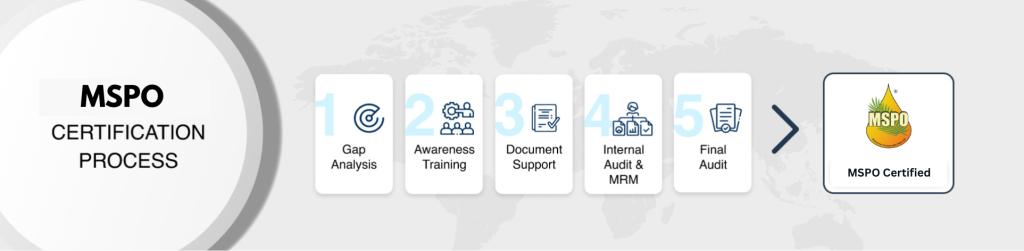
The Certification Process
Step 1: Gap Analysis
We visit your estate or mill to check your current practices against the MSPO (MS 2530) standard. We check your land titles, legal permits, and environmental conditions to see what is missing.
Step 2: Awareness Training
We teach your management and field workers about sustainable farming. We explain how to handle chemicals safely, protect wildlife, and respect workers’ rights.
Step 3: Document Support
We help you write the necessary policies and records. This includes your Sustainable Palm Oil Policy, safety manuals, chemical usage logs, and employment contracts.
Step 4: Internal Audit & MRM
We do a “practice run” audit to make sure your estate is compliant. We also help you hold a meeting with local communities (stakeholders) and management to fix any issues before the real audit.
Step 5: Final Audit
An external auditor (from an accredited certification body) inspects your site. They interview your workers, inspect the field conditions, and check your records to ensure you meet MSPO standards.
Step 6: Success!
Upon passing the audit, your estate or mill is officially awarded the MSPO Certification.
Frequently Asked Questions (FAQ)
Q: Is MSPO compulsory?
A: Yes. The Malaysian government has made MSPO certification mandatory. You risk losing your license to sell or process palm oil if you are not certified.
Q: What is the difference between MSPO and RSPO?
A: MSPO is the national standard (mandatory for Malaysia). RSPO is an international standard (voluntary). RSPO is often required for premium export markets, while MSPO is the baseline requirement for operating in Malaysia.
Q: Does this apply to smallholders (kebun kecil)?
A: Yes. Both independent and organized smallholders must be certified. However, the government often provides financial assistance to help smallholders lower the cost.
Q: How long does the certificate last?
A: The MSPO certificate is valid for 5 years, but you will have a check-up audit once a year to make sure you are still following the rules.