
Our Services
What is ISO/IEC 17025?
ISO/IEC 17025 constitutes the single most important global standard for the competence of testing and calibration laboratories. Unlike general management standards, it focuses strictly on technical proficiency, ensuring that laboratories have the requisite personnel, equipment, and protocols to generate valid, reproducible, and precise results.
Core Purpose: To provide a rigorous technical framework that validates a laboratory’s ability to produce precise and accurate data, recognized via the ILAC (International Laboratory Accreditation Cooperation) Mutual Recognition Arrangement.
Primary Objective: To assure customers and regulators of the laboratory’s technical competence, impartiality, and consistent operation, thereby facilitating the international acceptance of test reports and calibration certificates.
Applicability: Essential for any laboratory—whether independent, in-house, university-based, or government-run—performing testing, sampling, or calibration work that requires formal recognition of competence.
Benefits
Global Acceptance: Test reports issued by an accredited lab are accepted worldwide. This means your clients can export their products without re-testing in another country.
Gold Standard of Trust: It proves your results are accurate. Customers trust an “Accredited Lab” much more than a standard non-accredited one.
Win Government Tenders: In Malaysia, most government projects (JKR, MOH) and large corporations (Petronas) require test reports to come from a SAMM Accredited (ISO 17025) lab.
Reduce Re-testing: Because your results are proven accurate, you avoid the cost and time of having to repeat tests due to errors.
Staff Competence: The standard requires your staff to be technically competent. This ensures your team is highly skilled and professional.
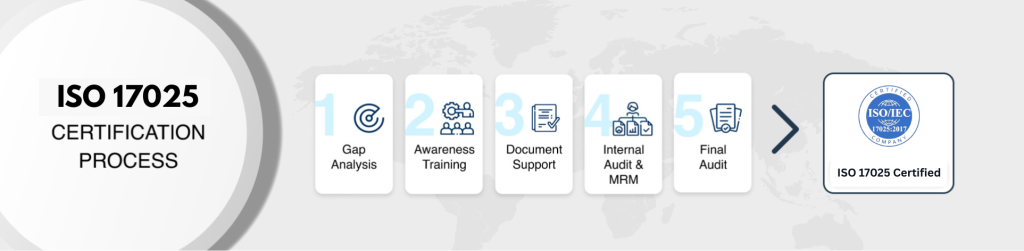
The Certification Process
Step 1: Gap Analysis
We inspect your laboratory environment, equipment, and staff. We check if your technical methods meet the strict ISO 17025 requirements and identify what equipment or skills are missing.
Step 2: Awareness Training
We train your Lab Manager and staff. We cover the two main parts of the standard: Management Requirements (documents/records) and Technical Requirements (method validation/equipment handling).
Step 3: Document Support
We help you prepare the complex technical documents. This includes your Quality Manual, Standard Operating Procedures (SOPs), and the difficult calculations for Uncertainty of Measurement.
Step 4: Internal Audit & MRM
We do a “practice run” audit to check your testing methods. We also hold a Management Review Meeting (MRM) to ensure the lab management is fully committed and ready.
Step 5: Final Assessment
Assessors from Department of Standards Malaysia (DSM) visit your lab. They watch your staff perform tests, check your equipment calibration, and review your reports to ensure technical competence.
Step 6: Success!
Upon passing the assessment and closing any findings, your laboratory is officially awarded ISO 17025 Accreditation (SAMM status).
Frequently Asked Questions (FAQ)
Q: What is the difference between ISO 9001 and ISO 17025?
A: ISO 9001 is for management (good paperwork). ISO 17025 is for technical competence (accurate results). A lab with ISO 9001 has good files; a lab with ISO 17025 has good files and proven accurate tests.
Q: Who gives the certificate in Malaysia?
A: Unlike other ISOs where private companies audit you, ISO 17025 is usually granted by the government body, Department of Standards Malaysia (Standards Malaysia), under the SAMM scheme.
Q: Is it difficult to calculate “Uncertainty of Measurement”?
A: It is the hardest part of the process. However, our consultants are experts in the math and statistics required and will guide your team on how to calculate it correctly.
Q: How long does the accreditation last?
A: The accreditation is valid for 3 years, subject to annual surveillance assessments to ensure your equipment and staff remain competent.
Track Record — Successful Clients:
Here are some of the brands and factories we have guided to full certification: