
Our Services
What is FSSC 22000?
FSSC 22000 (Food Safety System Certification) is a robust, globally recognized certification scheme for food safety management. It is fully recognized by the Global Food Safety Initiative (GFSI), making it one of the highest standards in the food industry.
Core Purpose: It integrates the ISO 22000 management standard with sector-specific Pre-Requisite Programs (PRPs) and additional FSSC requirements to create a comprehensive safety framework.
Primary Objective: To provide a rigorous, GFSI-benchmarked system that ensures the production of safe food, feed, and packaging materials, satisfying the demanding requirements of international retailers and major food brands.
Applicability: Designed for food manufacturers, packaging producers, and other organizations in the supply chain who require GFSI-recognized certification to operate in global markets.
Benefits
Global Market Acceptance (GFSI): Because FSSC 22000 is GFSI-recognized, it is accepted by the world’s largest retailers and manufacturers (such as Walmart, Nestlé, and PepsiCo) who often mandate this over standard ISO 22000.
Comprehensive Risk Management: Delivers a deeper level of protection by combining management systems with strict technical specifications for sector-specific hazards.
Streamlined Integration: Its foundation in ISO standards allows for easy integration with other management systems like ISO 9001 (Quality) or ISO 14001 (Environment).
Transparency and Trust: Demonstrates to stakeholders and consumers that your organization adheres to the strictest international safety protocols.
Continuous Improvement: Drives operational efficiency by replacing inconsistent client audits with a single, globally accepted certification.
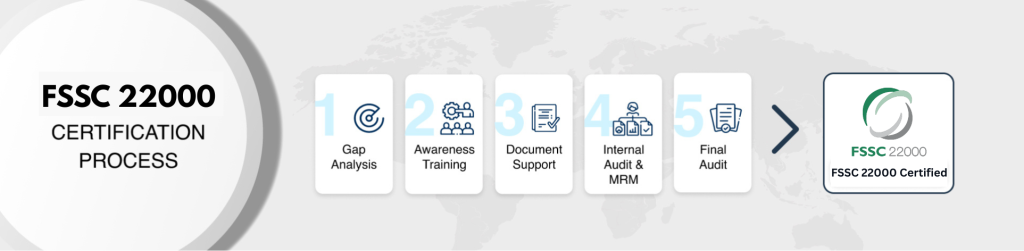
The Certification Process
Step 1: Gap Analysis
We conduct a comprehensive review of your existing processes against FSSC 22000 requirements, including the specific Pre-Requisite Programs (PRPs) relevant to your industry sector.
Step 2: Awareness Training
We deliver targeted training to your management and staff. We ensure the team understands the specific FSSC additional requirements, food defense mechanisms, and food fraud prevention strategies.
Step 3: Document Support
We assist in developing the extensive mandatory documentation, including your HACCP plan, Food Defense Plan, Food Fraud Vulnerability Assessment, and detailed technical specifications.
Step 4: Internal Audit & MRM
We conduct a rigorous Internal Audit to verify that both the management system and physical site conditions meet the standard. Following this, we facilitate a Management Review Meeting (MRM) to address any gaps.
Step 5: Final Audit
An approved Certification Body (CB) assesses your organization. This typically involves reviewing your documentation and a thorough site inspection to validate compliance with FSSC requirements.
Step 6: Success
Upon successful completion of the audit and closure of any non-conformities, your organization is officially awarded the FSSC 22000 Certification.
Frequently Asked Questions (FAQ)
Q: What is the difference between ISO 22000 and FSSC 22000?
A: The main difference is GFSI recognition. Big international buyers often require GFSI certificates. ISO 22000 is good, but FSSC 22000 is “higher level” and accepted by more large companies.
Q: Do I need a plan for Food Defense?
A: Yes. FSSC 22000 requires you to have a plan to stop intentional attacks (like someone trying to poison the food) and a plan to stop food fraud (fake ingredients).
Q: Is it hard to upgrade from ISO 22000 to FSSC?
A: Not really. Since FSSC is built on top of ISO 22000, you keep your current system and just add the extra “technical” rules required by FSSC.
Q: How long does the certificate last?
A: The certificate is valid for 3 years. However, you must have an audit every year to keep it.
Track Record — Successful Clients:
Here are some of the brands and factories we have guided to full certification: