
Our Services
What is Halal Certification?
Halal Certification constitutes a rigorous quality assurance mechanism which verifies that products, services, and supply chains operate in strict adherence to Shariah (Islamic) Law. Governed in Malaysia by the Department of Islamic Development Malaysia (JAKIM) under the MS 1500 standard, it validates not only the lawfulness (“Halal”) of ingredients but also the wholesomeness, safety, and hygiene (“Toyyiban”) of the entire production ecosystem.
Core Purpose: To provide an authoritative guarantee that products are free from non-Halal components (such as porcine derivatives or alcohol) and are processed in a hygienic, unpolluted environment.
Primary Objective: To facilitate consumer confidence and trade by ensuring absolute supply chain integrity, from raw material sourcing and logistics to manufacturing and final packaging.
Applicability: Essential for businesses in food and beverage, cosmetics, pharmaceuticals, and logistics seeking to penetrate the Muslim consumer market and leverage Malaysia’s globally recognized Halal ecosystem.
Benefits
Access a Massive Market: Over 60% of Malaysia’s population is Muslim. Without Halal certification, you miss out on the majority of local customers.
Global Recognition: The Malaysian Halal logo (JAKIM) is the most trusted and recognized Halal logo in the world. It makes exporting to the Middle East and Indonesia much easier.
Symbol of Quality: Halal is not just about religion; it is also about cleanliness and safety (“Toyyiban”). Non-Muslims often buy Halal products because they trust the hygiene standards.
Competitive Edge: Many supermarkets and large restaurant chains will not stock your product unless it carries the Halal logo.
Builds Trust: It gives Muslim consumers immediate peace of mind that your product is safe and lawful for them to consume.
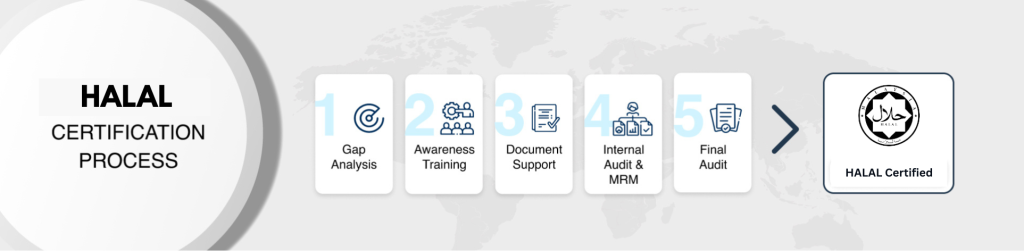
The Certification Process
Step 1: Gap Analysis & Ingredient Check
We review your entire operation. We check every single ingredient you use to ensure it is Halal-certified. We also check if your cleaning methods meet Shariah rules.
Step 2: Halal Awareness Training
We train your team on Halal principles. We also help you set up an internal “Halal Committee” (which must include Muslim staff) to oversee the process.
Step 3: Document Support (HAS)
We help you create the Halal Assurance System (HAS) file. This is a big file that proves you have control over your ingredients, storage, and production every day.
Step 4: Internal Audit
We conduct a “mock audit” to check your factory and paperwork. We ensure you are ready for the strict questions the government officers will ask.
Step 5: Final Site Inspection
Officers from JAKIM or JAIN (State Religious Department) visit your premise. They inspect your ingredients, your storage, and your production flow to confirm everything is Halal.
Step 6: Success!
After the officers report back to the Halal Panel, your company is approved and awarded the Halal Certificate.
Frequently Asked Questions (FAQ)
Q: Do I need Muslim staff to get Halal certified?
A: Yes. In Malaysia, you typically need at least two Muslim employees who are Malaysian citizens to be part of your Internal Halal Committee. They are responsible for ensuring Halal rules are followed daily.
Q: Does Halal only apply to meat?
A: No. Halal applies to all food, drinks, cosmetics, vitamins, and even logistics (transport). It ensures there is no alcohol, pork, or harmful ingredients hidden in the product.
Q: Can I apply for Halal if I don’t have GMP or HACCP?
A: You can, but it is harder. JAKIM strongly prefers companies that already have GMP (MS 1514) or HACCP (MS 1480) because it proves your factory is clean. If your factory is dirty, your Halal application will be rejected.
Q: How long does the certificate last?
A: The Halal certificate is usually valid for 2 years. You must renew it before it expires to keep using the logo.
Track Record — Successful Clients:
Here are some of the brands and factories we have guided to full certification: