
Our Services
What is Sedex (SMETA)?
Sedex (Supplier Ethical Data Exchange) constitutes one of the world’s leading ethical trade membership organizations, working with businesses to improve working conditions in global supply chains. The platform utilizes the SMETA (Sedex Members Ethical Trade Audit) methodology, which is an audit procedure based on the ETI Base Code and local laws, designed to evaluate an organization’s standards of labor, health and safety, environment, and business ethics.
Core Purpose: To provide an online platform where suppliers can share ethical data with multiple buyers, thereby increasing supply chain transparency and reducing the “audit fatigue” of undergoing multiple certifications.
Primary Objective: To objectively assess and report on working conditions, ensuring compliance with labor laws (such as working hours and wages) and ethical business practices.
Applicability: Critical for manufacturers and suppliers—particularly in food, agriculture, and manufacturing—who supply to major global retailers and brands that require visibility into ethical standards.
Benefits
One Audit for Many Clients: You don’t need a different audit for every customer. You do one Sedex (SMETA) audit and share the report with all your buyers (like Tesco, Nestlé, or Unilever) on the Sedex platform.
Keep Big Customers: Most major international brands require a Sedex audit. Without it, you might lose your contract or be unable to bid for new ones.
Protect Your Reputation: It proves you treat workers fairly. This stops bad news or scandals (like forced labor accusations) from hurting your business.
Fix Problems Early: The audit finds safety hazards or payroll mistakes so you can fix them before they become expensive legal problems.
Save Money: By reducing the number of audits you need to do, you save time and money on fees and preparation.
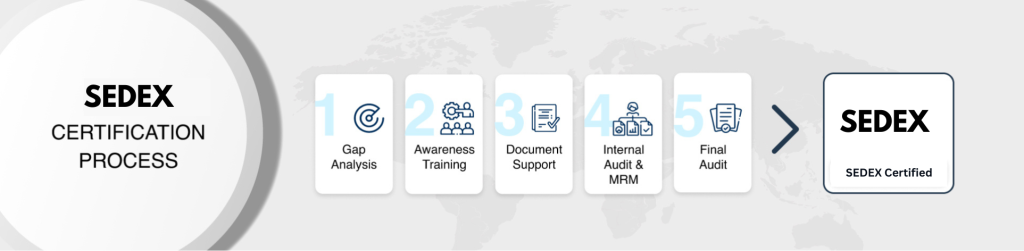
The Certification Process
Step 1: Gap Analysis
We inspect your factory and HR records to check your current status. We help you complete the required Self-Assessment Questionnaire (SAQ) on the Sedex system and identify any gaps in your ethical standards.
Step 2: Awareness Training
We train your management team on the SMETA audit requirements. We explain the difference between 2-Pillar and 4-Pillar audits and ensure everyone understands the ETI Base Code rules.
Step 3: Document Support
We help you organize the necessary records. This includes ensuring your payroll, overtime logs, worker contracts, and health & safety certificates are accurate and ready for inspection.
Step 4: Internal Audit & MRM
We do a “practice run” audit to find any problems. We interview workers and check the site to identify “Non-Conformances,” then hold a Management Review Meeting (MRM) to fix them before the real auditor arrives.
Step 5: Final Audit
An external auditor visits your factory. They review your documents, inspect the site, and interview workers to verify that you are treating them fairly and safely.
Step 6: Success!
Upon completing the audit, your final SMETA Report is uploaded to the Sedex system. You can then share this report with your customers to prove your compliance.
Frequently Asked Questions
Q: Is Sedex a Pass/Fail audit?
A: No. Unlike ISO, you don’t “pass” or “fail.” You get a report that lists “Non-Conformances” (problems). You must fix these problems (Corrective Actions) to satisfy your customers.
Q: Do I need a 2-Pillar or 4-Pillar audit?
A: It depends on your customer.
-
2-Pillar: Checks Labor Standards and Health & Safety.
-
4-Pillar: Checks the above PLUS Environment and Business Ethics.
-
Tip: If you are unsure, 4-Pillar is safer because it covers everything.
Q: Is Sedex a certificate?
A: Technically, no. You do not get a certificate to hang on the wall. You get an Audit Report in the online database. Your customers look at this report to approve you as a supplier.
Q: What is the difference between Sedex and SMETA?
A: Sedex is the organization and the online database where you verify and share your data. SMETA is the audit method (the actual inspection procedure). Think of Sedex as the “library” and SMETA as the “book” you put inside it. You conduct a SMETA audit and upload the report to the Sedex system.
Q: How often do I need an audit?
A: Usually, customers require a new audit every 1 year to ensure you are maintaining high standards
Track Record — Successful Clients:
Here are some of the brands and factories we have guided to full certification: